

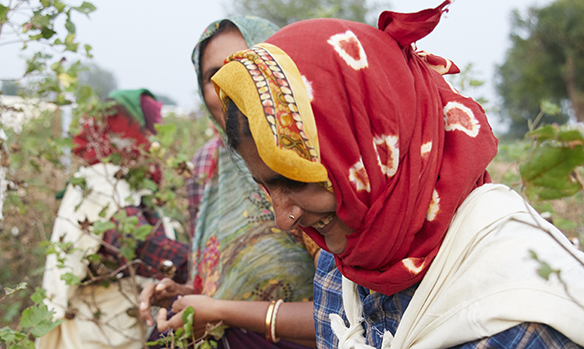
Since 2013, through the Primark Cotton Project we’ve trained 309,934Δ cotton farmers in our supply chain on farming practices that help to reduce the environmental impact of growing cotton and strengthen farmers’ livelihoods and resilience.
This flagship initiative has evolved to become the largest programme of its kind by a single fashion retailer. Based on a curriculum devised by agronomic experts CottonConnect, the training is delivered through local partners in India, Pakistan, Bangladesh and Türkiye. Nine out of 10 participants are smallholders1 and over 80% are women.
Focus on more regenerative farming practices
Although the Primark Cotton Project has always promoted best practices such as biological alternatives to synthetic pesticides and fertilisers, the focus on encouraging farmers in the programme to adopt more regenerative agricultural practices has grown in recent years.
Since 2023, the Primark Cotton Project’s curriculum has been based on CottonConnect’s REEL Regenerative Code, which sets out agronomic best practice across the growing and harvesting cycle. The curriculum has been further validated through review by agronomic experts at Harper Adams University. The practices taught are designed to work in sync with nature, aiming to improve soil health, enhance biodiversity and preserve water, which in turn supports the continued viability of cotton farming.
Our progress in 2024/25
As of March 2025, over 90% of farmers in the Primark Cotton Project have adopted at least two agricultural practices that are considered ‘more regenerative’ on their farmland.
These have included:
- reduced or no-tillage, minimising soil disturbance to preserve structure and sequester carbon
- cover cropping and intercropping, e.g., planting crops like sorghum between cotton plants or along borders to enhance nutrients and attract beneficial insects and birds
- crop rotation, alternating cotton with other crop species sequentially to break pest cycles, improve soil fertility, optimise nutrients in the soil, and diversify outputs for the farmers
- natural fertilisers, using farmyard manure, bio-compost or vermicompost to enrich soil organic matter, reduce the use of synthetic alternatives, and improve microbial life in the soil
- integrated pest management, using biological and ecological control methods that preserve beneficial insects, such as pheromone traps and bird perches
- incorporation of cotton stalks into the soil, instead of burning, to help maintain soil organic matter and sequester carbon
Understanding farmer preferences
Understanding local dynamics is vital to supporting effective regenerative agriculture. For example, 70% of programme farmers who rear livestock can make use of it as farmyard manure. This is a valuable natural fertiliser that supports soil health and offers a cost-effective alternative to purchased and synthetic inputs.
We plan to use these insights to support farmer groups to adopt practices tailored to their regions. Through our new ’graduate’ training programme, which delivers training to all farmers who have been through the three-year foundational training programme, we will be providing more targeted support to support adoption of such practices.
Measuring the Primark Cotton Project’s impact on biodiversity
It is likely to be several years before we see the impacts of the Primark Cotton Project farmer training on levels of biodiversity in our Primark Cotton Project sourcing regions. To help us measure these impacts, we have a Biodiversity Monitoring Programme aligned to guidelines from the International Union for Conservation of Nature, and frameworks such as Science Based Targets for Nature (SBTN) and the Task Force on Nature-related Financial Disclosures (TNFD). After design and pilot stages, monitoring began in March 2024 with surveys on 14 farms spread over five villages in the Indian state of Gujarat, working with our consultant partners Biodiversify and the Srushti Conservation Foundation.
Two of the villages contained Primark Cotton Project farms and three were control villages where farmers had not been trained in more regenerative agricultural practices. In each village, the farms and an area of natural habitat were monitored so that we could see how the farms performed in comparison.
We monitored plant and animal species and tested soil organic for carbon content as an indicator of soil biodiversity. We also assessed local farmers on their level of understanding about biodiversity and captured their observations about changes in the abundance of important species.
This year, regenerative agriculture experts at Harper Adams University reviewed the methodology of our Biodiversity Monitoring Programme against global best practice. We will review and incorporate the output of this review into our future work.
To maintain and scale farm monitoring over time, we are exploring a range of approaches and solutions. This has included working with our Primark Cotton Project partners in India, the Self-Employed Women’s Association (SEWA), which this year trained more than 31 of its field executives and coordinators in Gujarat with the skills and techniques for surveying biodiversity on farms.
1 Based on a definition from ISEAL, a smallholder farm in the developing world is typically a family-owned enterprise that produces crops or livestock on two or less hectares.
Human Rights Due Diligence in the Primark Cotton Project
Over the last year, we have been working with Impactt, a consultancy firm specialising in understanding and managing human rights issues. Our work with Impactt has focused on building a human rights due diligence (HRDD) framework for the Primark Cotton Project, based on the OECD Due Diligence Guidance for Responsible Supply Chains in the Garment and Footwear Sector.
During the initial stages, we have worked with CottonConnect at a strategic level to build a gap analysis and understand the roles and responsibilities of the different actors in the cotton supply chain. Impactt has also developed a monitoring framework, based on our Supplier Code of Conduct. This includes building out a methodology for field level assessments, the different way our partners define the severity of risks and potential response pathways.
In 2023, we piloted this framework in Türkiye on large-scale farms, where the main risks identified related to wages and occupational health and safety. We are now piloting the framework for smallholder farmers in India.